Four assumed pours from one bottle
Soft Drinks: An Illustrative Four-Pour Scenario
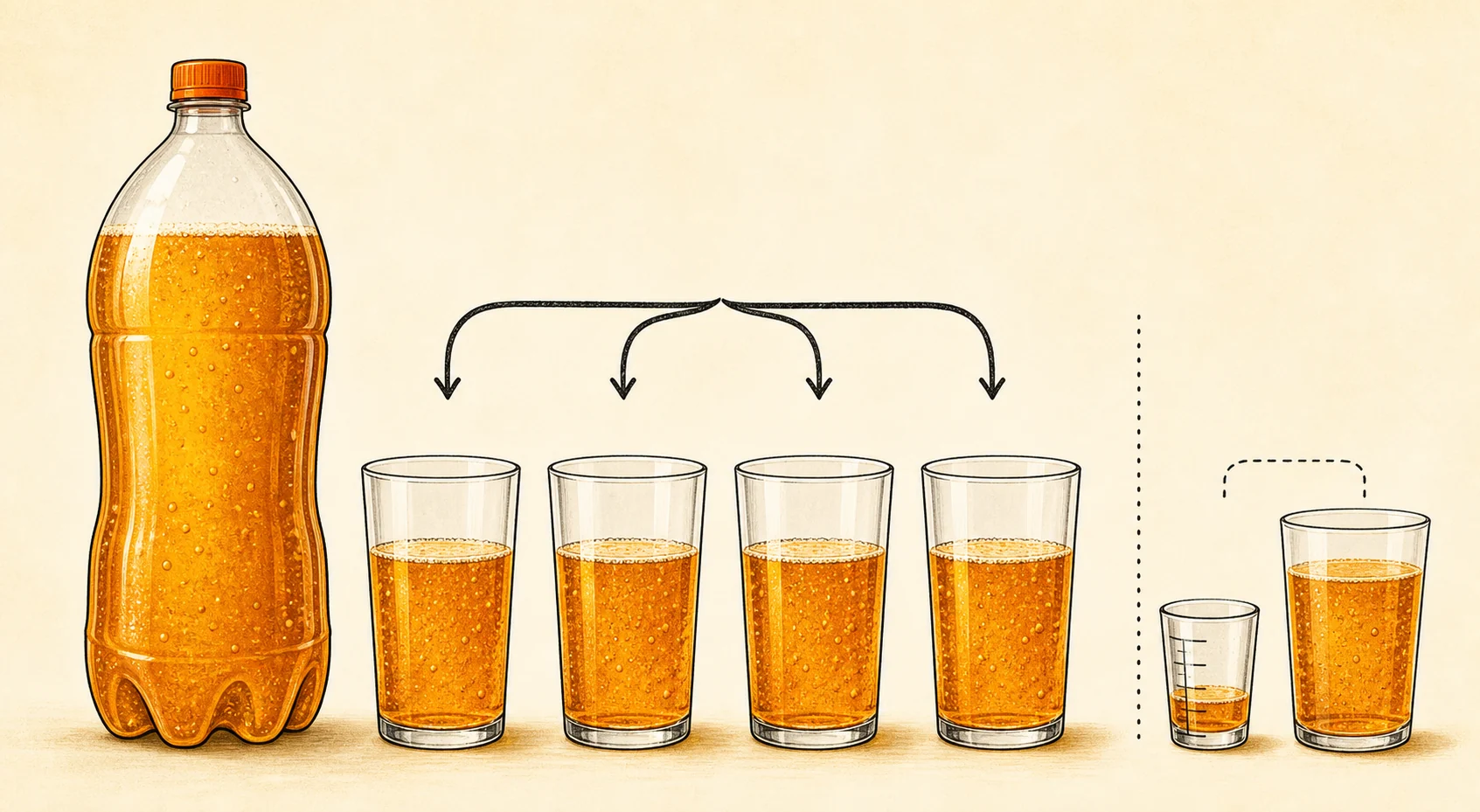
This example divides three large bottle sizes into four equal pours. It is a calculation, not an observation of drinking behaviour.
What we examined
We used bottle sizes of 2 litres, 1.25 litres and 900ml. Each bottle was divided by four to create an illustrative pour.
What the label may show
A declared label serving is the quantity used for nutrition information on a specific product in a specific market. It must be checked on that product or in a source that clearly records it.
Per-100ml data serves a different purpose. It standardises nutrition values for comparison and calculation; it should not automatically be described as the product's declared serving.
What it was compared with
The illustrative pours were compared with a 100ml reference amount. This shows how to scale per-100ml nutrition data, not how many declared servings someone consumed.
Data classification: bottle sizes and four-way division are illustrative assumptions. Pour sizes and multipliers are PerBiscuit calculations.
Results
| Illustrative bottle | Assumed division | Illustrative pour | Multiplier versus per 100ml |
|---|---|---|---|
| 2L | 4 equal pours | 500ml | 5.00× |
| 1.25L | 4 equal pours | 312.5ml | 3.125× |
| 900ml | 4 equal pours | 225ml | 2.25× |
If a drink contains 8g sugar per 100ml, the illustrative 500ml pour contains 40g. That result follows from multiplication; it does not show that 500ml is a reported portion.
Interpretation
Per-100ml data can be multiplied by the selected volume. A separate comparison with a label serving is valid only when that serving has been verified for the same product and country.
Limitations
- Four equal pours are an assumption. Sharing patterns and glass sizes vary.
- The example does not identify a brand, product variant or country.
- No user-reported PerBiscuit portions are used.
- The earlier product table was removed because the repository did not preserve enough source and country information to verify every row.
Why the information may be useful
The example separates two questions: how to scale per-100ml values, and whether a specific label serving matches a selected portion. Keeping those questions apart prevents a comparison unit from being mistaken for behavioural evidence.
Method and sources
Illustrative pour = bottle volume ÷ 4. Multiplier = illustrative pour ÷ 100ml. See the scenario method and source requirements.
Last reviewed and corrections
This scenario was last reviewed on July 14, 2026. Product-specific examples will remain unpublished until market, source and retrieval date can be shown. Please report issues through the corrections process.
Use your own amount
Compare a selected pour
Choose a sourced product and enter the amount you want to examine. Your selection is recorded as your report, not as a general claim.
Compare a portion